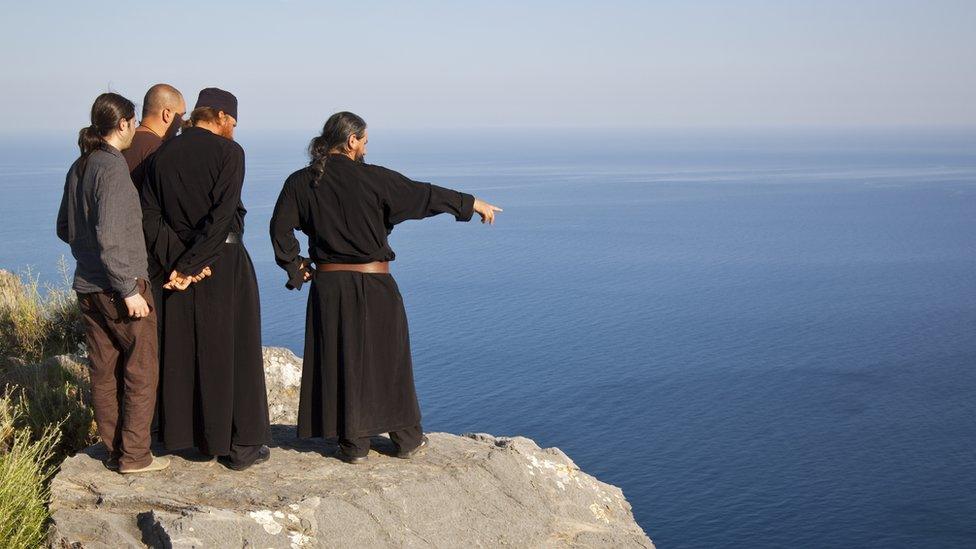
Having reached the end of my account of the pilgrimage, it is finally time to share some of my reflections.
The pilgrimage experience was a very humbling one, very symbolic of one’s sojourn on this earth (as I believe pilgrimages are meant to be). There I was, a lone stranger in a strange land, hardly knowing the language, not exactly sure as to what would happen on the way. I was, in many ways, dependent on the Lord’s mercy. I had to trust, especially when things seemed most out of my control, that He would provide, that He would come through. He had done so before, all those many years ago, in my hour of greatest need; would He not do so again even in the little things? Every kindness from a stranger became a manifestation of His solicitude for me, an occasion for thanksgiving; every difficulty, an opportunity to recognize my smallness, my weakness, and to call upon His Name. The tiredness, the fatigue, the hunger, the uncertainty – all of this played an important part in reminding me just how dependent I am upon the Lord. I also found meaning in the fact that one is only allowed to stay on Athos for three days and three nights. One is to be dead to the world – buried, if you will, in this strange place – for three days and then to return to it, only more alive. The silence of this figurative tomb is to bring about a listening and attentive heart.
I woke up a bit before 3AM, to the sound of the semantron, and eventually made my way down to church for the Office, which lasted until around 5AM. I then went back to my room to rest a little until it was time to leave. Upon entering the room, however, I saw a certain insect parading around on the bed next to mine. I immediately inspected my own bed, and while I didn’t find any undesired bedfellows in my own bed I didn’t sleep very well after that, constantly waking up thinking I felt something crawling on me.
I left Koutloumousiou around a quarter past 9 and made my way to the cafe in Karyes. As I had breakfast some pilgrims came to return some sweat bread (?) they had just bought. I didn’t understand the conversation, but the chap running the cafe eventually took away all the breads he had for sale. I had bought one myself, and he seemed to notice that I was looking at him, but he made no mention of what was wrong. I ended up binning mine when I left. “Better safe than sorry,” I thought. Before leaving I asked which van was headed to Daphne, but found out that there was no specific one. Even on my last day I wasn’t to have a breather, so I wandered around asking people if they were headed to Daphne. I eventually met a man, possibly Northern European and in his late 50s, who was also leaving Athos, so I decided not to wander too far from him. We found the van going to Daphne, which from my estimate would give me just about enough time to buy the ferry ticket before boarding. Another van, driven by an Eastern European chap, stopped in the plaza in the meantime, the driver announcing that it would be departing in the next few minutes. While that would have permitted me ample time to arrive at Daphne and look about, the comments the Greeks were making about the driver put me off.
I stopped just outside the gates of Pantokratoros and surveyed the landscape, my eyes following the road I had taken just the day before. Only the road was all downhill the previous day; now, I had a very, very long walk uphill, and that was just to get to the point where the monks had dropped me off. I had no idea how far it was from there to Karyes or what kind of terrain lay ahead. It was a bit drizzly and windy and I thought “Lord, I wouldn’t mind a bit of Your charity again, like yesterday. But, like in all things, Your will be done” and then set off. I was walking for about some 10-15 minutes when one of those very typical vans one sees about Mount Athos, going in the same direction as I was, stopped next to me. A monk opened the window and asked for my destination. “Karyes.” He opened the door and told me to jump in. Providence once again. I was greeted by a number of Greek faces packed tightly together. One of the chaps wasn’t inclined to make space in the seat next to him, telling me to head to the back (where there was no space at all), but eventually the other occupants hassled him enough that he made space for me next to him. Off we went, once more up winding roads. I let my eyes stroll along the scenery as I said some prayers of thanksgiving, and thankful indeed I was, for it took us a good 20-25 minutes to reach Karyes, ascending all the while. The monk stopped not too far from the centre and let me out. “Evcharisto para poli,” I thanked him. I now had more than enough time to reach Koutloumousiou which, according to my GPS, was a mere 10 minutes walk from my current location. I sat down for a bit and was surprised to see the young teenage monk I had seen previously at Pantokratoros pass by. Some time later a large crowd of young teenagers dressed in cassocks, again roughly the same age as the one I had seen before, passed by and went into a building. I wondered what exactly they and the building might be, but I was feeling hungry and put those considerations aside for the time being.
Karyes seemed quite busy this morning (or perhaps I was just too anxious on my first day to have noticed properly), with pilgrims flooding the streets, as well as monks everywhere. Monks on mobile phones, monks running stores, monks buying provisions at the hardware store, the mini-market, cars and all terrain vehicles passing through, etc. I remembered seeing a cafe near where I had previously caught my ride to Philotheou, so I headed there. I entered the small establishment (which looked very much like a rural Portuguese cafe apart from all the icons covering one of the walls) and was greeted by a Greek chap in his late 30s, full of tattoos and a huge undercut hairstyle. I bought a veggie burger and an orangeade, went out to have my meal in the open air and do some people watching. Looking around at the groups of men wandering the streets, some laughing very loudly, others drinking alcohol and smoking, one had the feeling of being at a sort of guys club; the local taverna also added to this feeling. In this kind of atmosphere one almost forgot that one was at the “mystical heart” of the Eastern Orthodox world. Some meowing of the local cats soon dragged me out of my musings. As I mentioned before, cats are ubiquitous on Mount Athos. Only, they’re not clean, fat pets. These are sleek, almost skinny, cats that wander the streets. I would almost say they were feral, but they seem quite used to people, going so far as to allow you the honour of petting them (neither will they shy away from you sparing them a morsel).
A Portuguese man drinking orangeade in Greece – the joke practically writes itself.
A foggy morning on Athos, but alas, no sign of D. Sebastian of Portugal.
I wandered into the cloister, not sure exactly where I was going, but knowing that I needed to find the guest house. A monk and some pilgrims were speaking in front of the catholicon; the monk greeted me and told me to make my way to the guest house. I wandered around for a bit in the cloister, unsure of where the guest house was, until an older Greek gentleman asked me what I was looking for and then pointed me in the right direction. I went into a large room furnished with some sofas, a table with loukoumia and water (but no tsipouro), a grandfather clock and a large table with the guestbook. The room was dimly lit, the only source of light being what little sunlight came in through the windows. I was expecting to find the guest master there, but the only person I could see in the dark room was a man sat (sleeping?) on one of the sofas. I filled out the book, expecting someone to come in; a few minutes passed so I helped myself to some loukoumia and water. Some more time passed and I went out onto the veranda on the other side of the room, which overlooked the sea. The sky was completely grey; the wind was picking up, and the waves crashed noisily against the rocks jetting out from sea below.
I had noticed that we had passed the monastery of Iviron on the way to Philotheou the previous day, so I decided to use it as a gauge for the hike. My mobile’s GPS said that it would take me almost two hours to reach Iviron, so I went on my way.Birds were chirping all about and the warm sun made for an encouraging walk.Still, I took out my emergency whistle and kept it at hand. What was I doing with a whistle, you ask? In preparing for my trip I had thought it might be a good idea to have one given that I would be walking paths all alone, paths which I was completely unfamiliar with. That being said, some online comments I had read a month previous to my trip alarmed me a bit. Tales of the local fauna, especially two certain kinds – vipers and wolves – and how it was not a good idea to be walking out there alone. And besides, weren’t there tales of the occasional pilgrim or monk who met a grisly death by accidentally falling down a cliff after having lost their way? These comments did their magic on a nature already prone to worry and suddenly the whistle seemed indispensable.
I followed the others through the cloister, then up some stairs past an elaborate wooden door (which I later discovered was the refectory) and into the large building which served as the pilgrims’ quarters. While a small, elderly monk with a large white beard attended to the Greeks, I was approached by a young monk. He must have been in his 30s, with a thick black beard, brown eyes and an olive complexion; he had a soft, but firm voice, and spoke English very well. He asked me to fill out out the guestbook (which one is obliged to fill out at each monastery; it was only after leaving Greece did I understand why all the books had an entry for the guest’s father’s name) and then led me to a refreshment room. On a table there was some water, a very small glass of anise-flavoured tsipouro (a spirit similar to ouzo) and a bowl of loukoumia (Greek Turkish delight), with some napkins next to them. I had a loukoumi, which was quite tasty and uplifting after the exhausting morning with little to eat besides a spanakopita (spinach-filled philo pastry) on the ferry and the few crisps the elderly gentleman had offered on the trip to the monastery; I downed the shot of tsipouro, which was stronger than I expected, and chased it with a glass of water. The young monk, whose name I did not get – because it had not been given – asked me if I was looking to become Orthodox or if I was on Athos for a different reason. When I replied that I was not looking to become Orthodox, he left it at that and then quickly talked me through the timetable, informing me as well that pictures were not allowed inside the church, the refectory or of monks (so most of the pictures in this post of the interior of the catholicon are from other websites). He was quite apologetic when explaining that I would not be allowed to join the monks in church during prayer times (I was only allowed as far as the exonarthex, which is the covered vestibule just before the narthex) or during meals as I was not Orthodox; I replied that I was aware of that and would do my best to respect their rules. I was then left to my own devices until Vespers.
The van started off for Karyes on a road that followed the coast for a bit. The road was hardly paved, though there was some construction work going on; still, stones and debris littered the road, which made for a slow pace. Eventually we began to ascend uphill, occasionally coming upon some patches of concrete pavement. The concrete pavement, alas, did not cover that much of a distance and suddenly we were on a zigzagging dirt road up the contour of the hill. Huge potholes littered the path and so the van would drive on whichever side of the road was most convenient to avoid them (as long as there was no oncoming traffic, which there wasn’t apart from an occasional lorry). It was quite boisterous in the van, but I didn’t pay much attention to the conversations around me. Rather, my attention was fixed partly on the seats which swayed from side to side every time we hit a rough patch, partly on the scenery outside. I doubt we were going at more than 30 mph as we winded up the hill, so I could take it all in. Somewhat alarming (to me at least) was the lack of any barriers on the escarpment side of the road; all one could see were steep rocky cliffs with some sparse vegetation. Silly fears aside, the scenery was breathtaking, as the higher up we ascended the more of the coastline we could see – the serene waves of the Aegean; some islands off in the distance; Mount Athos once more looming in the distance.
The further up we went the thicker the vegetation became and gradually the road’s slope decreased, eventually levelling out. We continued on and soon small houses could be seen here and there in the hills and surroundings; I vaguely recall seeing some signs pointing to sketes (smaller monastic communities) and perhaps monasteries at this point. After what was perhaps an half an hour’s ride larger buildings and actual roads nestled by walls came into view. We had arrived at Karyes. The van stopped at a plaza and we all spilled out of the van, grabbed our backpacks and then each went his own way. I scanned the surrounding area. A few colourful shops with glistening icons and flags of the Greek Orthodox Church; a small cafe out of which exited men with frappés; a monk on the threshold of shop door, arms folded as he leaned against the opening, watching those coming and going (this could easily have been a scene taken from my family’s village back in Portugal, sans monk); monks on mobile phones (!); cats; more men arriving in the plaza, while others departed.
I arose early the following morning, as I was unsure how long it would take to sort out my diamonitirion and ferry ticket. I exited the hotel and was greeted by a clear blue sky and the warm sun. Much to my surprise, the town which had just the previous day been nearly deserted was now bustling with life. The streets were teaming with groups of men, coaches pouring in from the main road, and all around cigarette smoke and loud voices filled the air. I made my way to the Pilgrim’s Office; here, a short and orderly queue at the door. I made my way to the first desk, where a police officer (?) checked my passport. He took some time studying it, causing me to become a bit nervous. Finally he read my name aloud and told me to carry on to the next desk. I handed my passport over to the clerk, who also took some time looking at it and indicated that I should go to the next clerk. A cold sweat broke out. “Is something wrong? Am I not going to get my visa? Did I forget to do something?” Useless worries. The following clerk had a glance at the passport, dug out my diamonitirion and asked for the fee. A sigh of relief.
I have returned home safely from my long desired pilgrimage to Mount Athos. As promised, I will write an account of what I did and saw. I will be breaking this account into two main parts: the first, an account of the trip in se; the second, my thoughts and reflections. So, without further ado, onto the pars prima.
Today I write to you about a pilgrimage that I will be making this coming March and that has been nearly 2 decades in the making. God willing, I will finally be visiting the “Holy Mountain” – Mount Athos. For those of you unfamiliar with it, Mt. Athos is a mountain on the Athos Peninsula in Greece and home to a number of Eastern Orthodox monasteries. Rather than burden you here with a description, I point you to the Wikipedia article, which is quite to the point.
I first heard of Mount Athos shortly after my conversion (perhaps even within the first year) and almost immediately I gained a desire to visit it. Indeed, at the time I even spoke with someone who lived in my city and happened to have visited Athos once or twice (I was quite surprised at the time that one of my fellow countrymen had even heard of it, let alone stepped foot there), in hopes that I would be able to plan a trip in the meantime, but that day never came. Years came and went, and while the desire waxed and waned, it never went away. “One day, God willing, I will visit.”
I’m sure you’re probably asking yourself why I – a Roman Catholic – would have any interest at all in visiting Mt. Athos, which is essentially an Eastern Orthodox site (there was, once upon a time, a Benedictine monastery there – Amalfinon – but it disappeared a couple of centuries after the Great Schism), especially since some Athonite monks don’t particularly care for Catholics. There are a few reasons why, and I will try to share those with you in this post.
First of all, there’s no place quite like it in the Roman Catholic world, at least not currently; if there ever was post-Schism, I’m not aware of it. Athos is a monastic republic, and no women are allowed on the island; not even female domestic animals (apart from cats) are allowed! There has been an uninterrupted tradition of the monastic life there for centuries, if not a millennium, though it has waxed and waned as well. At the beginning of the 20th century a number of Benedictine monks made their way to the Holy Mountain, in search of certain ancient texts, and from their writings we know that what they saw on Athos opened their eyes to the meaning of certain more obscure or difficult passages of the Holy Rule of St. Benedict.
Secondly, I am curious about what Athonite devotion to Our Lady is like (legend has it that she was the only woman to ever set foot there). I am hoping that what I learn of their devotion might better help me understand, as a Roman Catholic, what a sound devotion to the Blessed Mother looks like.
Thirdly, I hope to venerate some well known relics and (wonder working) icons there.
Fourthly, I want to experience monastic Byzantine liturgy. I have had a chance to attend UGC liturgies, and even once a Greek Orthodox Divine Liturgy, but these were all at parishes and necessarily “toned down”.
Fifthly, I want to see how these men live in the current age the life passed down from the holy fathers. It was on Mount Athos that the Philokalia was compiled, during one of its spiritual renaissances. Given my penchant for the Desert Fathers and the monastic life in general, I want to see what it is like at that place.
Look – that blogger is coming! Are you sure we should let him in?!
Could there be any other reasons? After the past year, with all its setbacks and difficulties both financial and health-wise, perhaps I am in search of some wonder/miracle? Perhaps some part deep down is searching for that as well. Or perhaps I am just searching for “a word”. I do not intend, however, to become Orthodox, and neither should this trip be seen as any “searching” of that kind. I also am under no illusions about what I will find there. I know that it is not a paradise, filled with holy, saintly men. It is a place where men go to wage spiritual warfare, just like any other place where there are religious. That there may be some very holy men there, I have no doubt. But, in general, I’m quite sure I will find men struggling with the passions, not that much different from you or I; different, perhaps, only in the way Our Lord has called them to be faithful to Him.
For those that would like to help with the costs of this pilgrimage, I have set up a crowd funding account; for anyone donating £25/$25, I will make sure to send you something special from Athos.
I hope to dedicate a post or two to the pilgrimage after I have returned, so please keep an eye out.